Securing Autonomous AI Agents on Kubernetes with OpenShell and CNCF Ecosystem Integration

The rapid proliferation of autonomous AI agents within enterprise environments has introduced a significant new attack surface for infrastructure administrators. Unlike traditional microservices that interact with predictable APIs, modern AI agents are dynamic, often executing arbitrary code, installing packages, and initiating network connections based on volatile instructions pulled from the internet. As these agents frequently hold privileged credentials to access internal systems and sensitive data, they represent a critical security vulnerability if left unmanaged. OpenShell, an initiative originally spearheaded by NVIDIA and now a formal Cloud Native Computing Foundation (CNCF) Sandbox project, provides a robust runtime framework designed to contain these risks. By leveraging Kubernetes-native primitives and integrating with policy engines like Kyverno, OpenShell offers a sophisticated approach to sandboxing that addresses the inherent trust deficit in agent-based computing.
The Evolution of Agent Security
The core challenge in deploying AI agents lies in their operational nature. An agent is effectively untrusted code that requires access to system resources to perform useful tasks. Traditional Kubernetes security mechanisms, such as NetworkPolicies, are often too coarse to manage the granular requirements of an agent. A standard NetworkPolicy can restrict a Pod to communicating with a specific endpoint, but it cannot differentiate between a legitimate request to read a file and a malicious attempt to exfiltrate database contents.
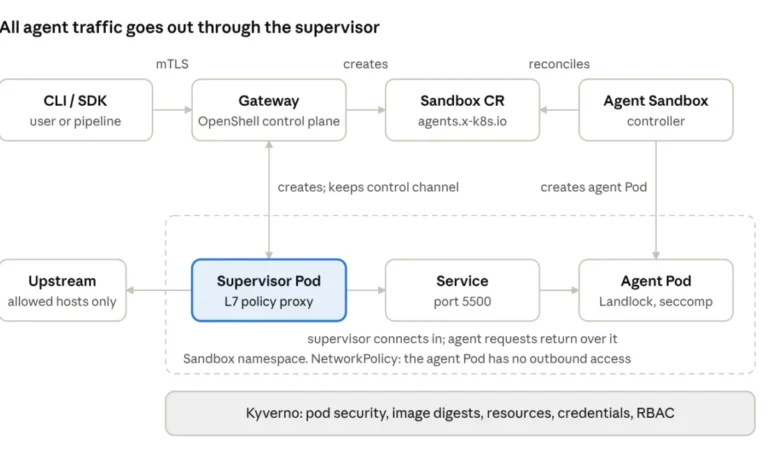
OpenShell solves this by decoupling the agent’s execution from its capability to interact with the environment. It acts as a supervisor, sitting outside the sandbox and arbitrating every request the agent attempts to make. This allows administrators to declare specific controls—such as which binaries are permitted to execute or what network traffic is allowed—using declarative YAML configurations. Because these rules can be updated on a running sandbox without requiring a service restart, organizations gain the agility needed to respond to emerging threats in real-time.
Architectural Foundations and Integration
OpenShell does not attempt to reinvent the Kubernetes scheduler. Instead, it relies on the SIG Apps "Agent Sandbox" project, which uses standard Kubernetes resources like Pods, Services, and Persistent Volume Claims (PVCs) to represent agent environments. This design choice is significant for cluster administrators, as it allows them to use familiar monitoring and management tools to oversee agent lifecycles.
When an agent is triggered, the OpenShell gateway instantiates an Agent Sandbox. A supervisor container, deployed alongside the agent, intercepts all outbound traffic and system calls. If the agent attempts to perform an action that violates established security policies, the supervisor blocks the request. This "supervisor-per-agent" model provides strong isolation, ensuring that even if a specific agent is compromised, the breach remains contained within its dedicated sandbox environment.
Comparative Landscape: OpenShell vs. Agent Substrate
The landscape for secure AI execution on Kubernetes has expanded rapidly, notably with the emergence of Agent Substrate, a Google-led project that also attained CNCF Sandbox status in September 2026. While both projects aim to solve the problem of secure agent execution, their architectural priorities differ significantly.
OpenShell is designed for high-fidelity control, focusing on the question: "What is this agent permitted to do?" It is ideal for environments where agents handle sensitive credentials and require per-request auditing. Conversely, Agent Substrate is optimized for density and cost-efficiency. It utilizes a "worker pool" model where multiple idle agents can be suspended and resumed in milliseconds, making it highly effective for scenarios involving thousands of intermittent, low-priority tasks.

The industry is currently witnessing a push toward convergence. RFC 0012, merged in September 2026, allows OpenShell to treat isolation as a pluggable backend. This has led to active discussions regarding the integration of Substrate as an isolation engine for OpenShell. If successful, this would provide users with the best of both worlds: the granular policy and credential management of OpenShell combined with the resource efficiency and rapid resume capabilities of Agent Substrate.
Kyverno: The Policy Layer
While OpenShell manages the runtime behavior of an agent, Kubernetes-native policy engines like Kyverno are essential for enforcing governance at the admission control level. Relying solely on Role-Based Access Control (RBAC) is insufficient, as RBAC governs user permissions but cannot validate the content or configuration of the resources being deployed.
By implementing Kyverno policies, administrators can enforce strict guardrails on every sandbox request. These policies can prevent common misconfigurations, such as:
- Privileged Execution: Ensuring no agent runs with root privileges or elevated capabilities.
- Supply Chain Integrity: Requiring that all agent images are referenced by immutable SHA-256 digests rather than mutable tags.
- Resource Capping: Preventing agents from consuming excessive CPU or memory, thereby protecting the overall cluster stability.
- Credential Protection: Mandating the use of OpenShell’s native credential providers instead of risky injection methods like standard Kubernetes Secrets.
These checks occur during the admission phase, meaning that even a privileged user or a compromised gateway account cannot bypass these security requirements. For enterprises, this creates a layered defense strategy where Kyverno handles the infrastructure compliance, and OpenShell manages the application-level runtime safety.
Industry Implications and Future Outlook
The shift toward agentic workflows marks a permanent change in how applications are constructed. As LLMs become integrated into the core of enterprise software, the infrastructure supporting them must evolve from static, perimeter-based security to dynamic, intent-based governance.
The current maturity of OpenShell (v0.1.x) suggests that while it is ready for experimental and pilot environments, it is still evolving toward enterprise-grade stability. The primary hurdle remains the scaling of the supervisor-per-pod model. As noted in the project roadmap, the introduction of more flexible deployment models and the potential adoption of gVisor-based backends will be critical for large-scale production adoption.
For platform engineers, the recommendation is clear: evaluate workloads based on their risk profile. If an agent operates within a high-security context—handling PII, financial transactions, or production system credentials—the per-request oversight provided by OpenShell is currently the gold standard. For massive, ephemeral workloads where cost is the primary driver, monitoring the progress of Agent Substrate and its potential future integration with OpenShell is the prudent course of action.
Chronology of Recent Developments
- September 10, 2026: RFC 0012 is merged into OpenShell, establishing the foundation for pluggable isolation backends.
- September 20, 2026: The CNCF Technical Oversight Committee officially accepts OpenShell as a Sandbox project.
- September 28, 2026: Agent Substrate is accepted as a CNCF Sandbox project, marking a formalization of the two competing approaches.
- October 11, 2026: Ongoing community discussions regarding versioned transports for external backends continue, signaling the project’s focus on long-term architectural extensibility.
- November 4, 2026: Documentation and demonstration materials are released to help early adopters test the interplay between OpenShell and Kyverno policy enforcement.
As the cloud-native ecosystem continues to refine the standards for AI security, projects like OpenShell demonstrate that the community is prioritizing secure-by-default architectures. By abstracting the complexity of sandboxing while maintaining deep integration with existing Kubernetes patterns, OpenShell provides a viable path forward for organizations eager to harness the power of autonomous agents without compromising the integrity of their production infrastructure. The combination of runtime supervision and admission-time policy enforcement represents a mature, scalable security model that will likely become the industry standard for AI agent deployment in the coming years.
Related posts: